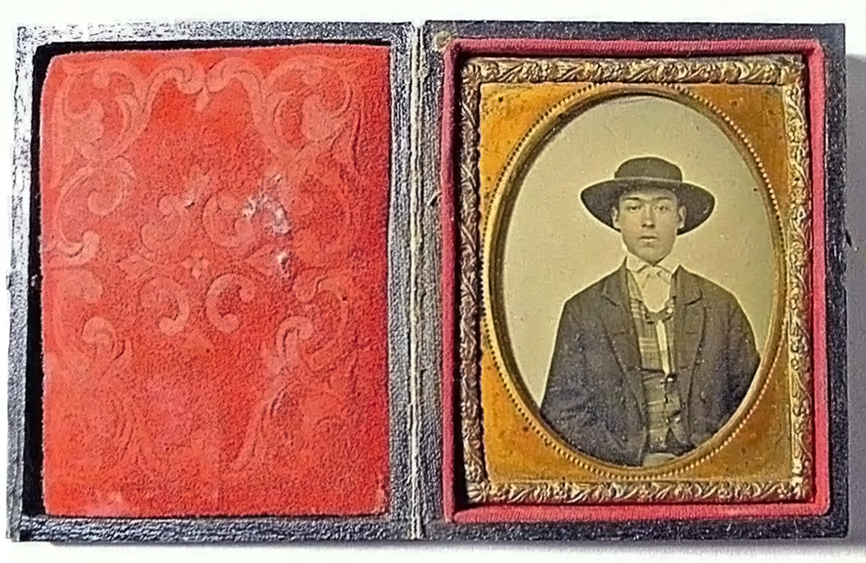
 名称: Chinese/华工肖像
类别: Ambrotype photo/玻璃照片
日期: 1860
尺寸: 6.3x9.2cm


James Ambrose Cutting (1814-1867) was a 19th-century American photographer and inventor, recognized as one of the pioneers of the Ambrotype photographic process. In 1854, he received three U.S. patents (Nos. 11,213, 11,266, and 11,267), establishing the technical standards for glass-plate wet-collodion photography. This process involved coating a glass plate with a wet collodion solution, exposing it to light to form a negative, and then presenting a positive image against a dark background, producing high contrast and finely detailed images.

詹姆斯·安布罗斯·卡廷(James Ambrose Cutting,1814-1867)是19世纪美国摄影师和发明家,被誉为“安布罗法”(Ambrotype)摄影工艺的奠基人之一。他于1854年获得了三项专利(专利号11,213、11,266和11,267),确立了湿版玻璃正像摄影法的技术标准 。这一工艺通过在玻璃板上涂布湿版胶棉溶液,曝光后形成负像,再通过黑色背景呈现正像,具有高对比度和细腻的质感。

Ambrotypes gained widespread popularity from the mid-1850s to the early 1860s, becoming one of the mainstream forms of portrait photography. The works were typically mounted in metal or leather frames, small in size, making them convenient for display and personal collection. Photographers often hand-colored the images on glass plates to enhance facial features and accessories, giving the works a distinctive artistic charm.

Although the Ambrotype process was eventually supplanted by more efficient paper-based photographic methods by the late 19th century, Cutting’s contributions remain significant in the history of photography. Many museums and private collections preserve Ambrotype works as valuable records for studying 19th-century American society, fashion, and portraiture. For example, the Library of Congress holds Ambrotypes from Cutting and his contemporaries within the Liljenquist Family Civil War Collection. Additionally, the Puke Ariki Museum maintains Cutting’s works, showcasing the visual style of 19th-century American portrait photography.

Cutting’s invention not only advanced photographic technology but also provided later photographers with new avenues for artistic expression. Today, his works are regarded as precious heritage in the history of photography, offering critical insights into both technical innovation and 19th-century American visual culture.

This photograph is exquisitely mounted in a box lined with velvet, reflecting a high level of craftsmanship. In the 19th century, glass-plate photographs of Chinese subjects were extremely rare, making this work not only historically valuable but also illustrative of the lives of early Chinese people in North America.

安布罗法在1850年代中期至1860年代初期广受欢迎,成为肖像摄影的主流形式之一。其作品通常被镶嵌在金属或皮革相框中,尺寸较小,便于携带和收藏。摄影师常在玻璃板上手工上色,增强人物面部和饰品的表现力,赋予作品独特的艺术魅力。

尽管安布罗法在19世纪末期被更高效的纸质摄影形式所取代,但其在摄影史上的地位依然重要。许多博物馆和私人收藏机构保存了大量安布罗法作品,作为研究19世纪美国社会、服饰和肖像艺术的重要资料。例如,美国国会图书馆的莉尔金奎斯特家族内战摄影收藏中,就包含了由詹姆斯·卡廷及其同时代摄影师创作的安布罗法作品 。此外,普克阿里基博物馆(Puke Ariki Museum)也收藏了卡廷的作品,展示了19世纪美国肖像摄影的风貌 。+++

卡廷的发明不仅推动了摄影技术的发展,也为后世摄影师提供了新的艺术表达方式。他的作品至今仍被视为摄影史上的珍贵遗产,值得我们珍惜和研究。这幅照片被精美地镶嵌在带绒布衬底的盒子内,体现出高度工艺水平。在19世纪,拍摄中国人物的玻璃板照片极为罕见,因此此作品不仅具有珍贵的历史价值,也展现了早期中国人在北美的生活状态。 >>返回>>

 PHOTO影像