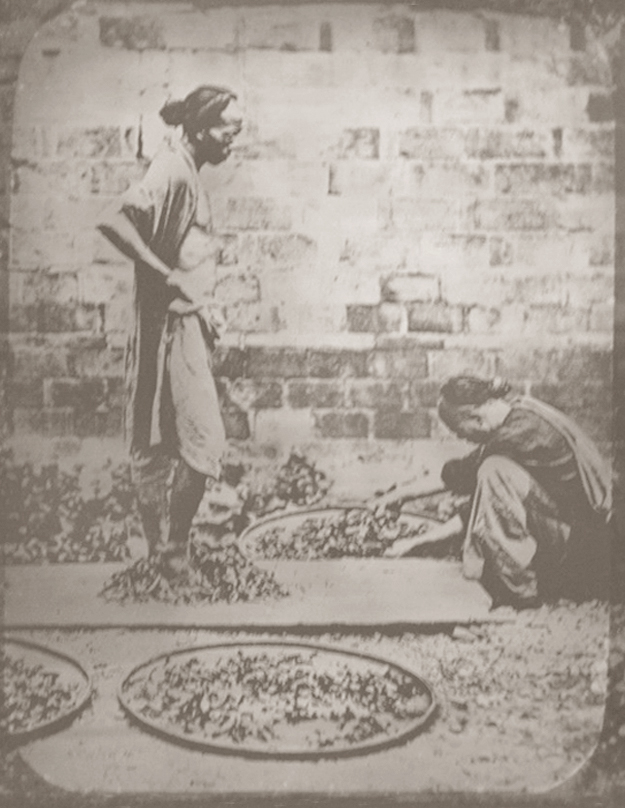
 名称: Choose Tea Leaves/选茶叶
类别: Glass Slides/玻璃底片
日期: 1873
尺寸: 9x11cm
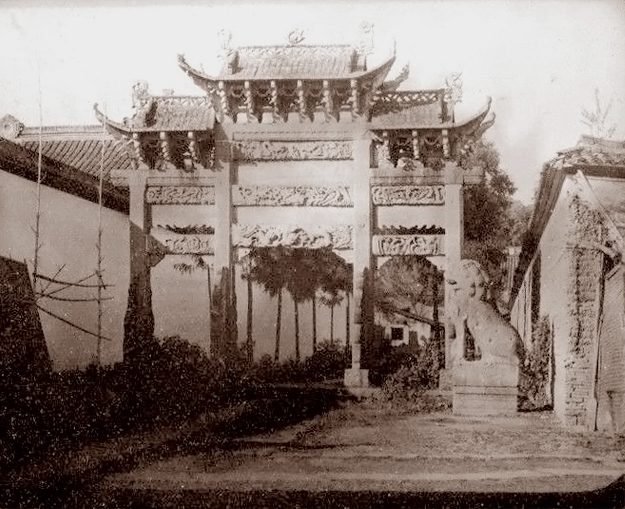 名称: Yangloudong Town, Hubei, China/湖北省羊楼洞镇
类别: Glass Slides/玻璃底片
日期: 1873
尺寸: 9x11cm
Note: 羊楼洞镇位于赤壁市区西南26公里的羊楼洞镇,为湘鄂交界之要冲。明清之际系蒲圻(今赤壁市)6大古镇之一,"松峰茶"原产地,素有"砖茶之乡"的美称,大卫•格里菲斯于1873年羊楼洞镇考察拍摄古镇一景。
David Knox Griffith (1841-1897), a British photographer born in Dublin and later based in London, was a gifted image-maker deeply fascinated by Chinese culture. In the early 1870s, while in London, he published several essays on Chinese photography, introducing the state of its development to a wider international audience. He subsequently spent nearly twenty-five years living and working in Shanghai and Hong Kong. From 1872 to 1875, he served as an assistant to the noted photographer William Saunders in Shanghai, and in 1880 he worked in the Hong Kong studio of the celebrated photographer Afong Lai. Griffith later established and operated his own studio in Hong Kong between 1885–1887 and 1890–1897, with a brief return to London in between.
大卫·格里菲斯(David Knox Griffith,1841-1897),英国摄影师,生于都柏林,长期定居伦敦,是一位才华横溢并对中国文化怀有浓厚兴趣的影像记录者。他不仅在1870年代于伦敦发表过多篇中国摄影评论,积极向世界介绍中国摄影的发展,还在上海和香港工作、生活达25年之久。1872年至1875年间,他在上海担任英国摄影师威廉·桑德斯(William Saunders)的助手;1880年则在香港著名摄影师阿芳(Afong Lai)的影楼任职。其后,他先后于1885年至1887年以及1890年至1897年在香港创办并经营个人工作室,中途曾返回伦敦数年。
Although long overlooked in the broader narrative of early Chinese photography, Griffith’s career and work hold significant historical and artistic value. In the summer of 1873, under the commission of Li Hongzhang’s foreign advisor, Gustav Detring (known in Chinese sources as Magri), Griffith undertook a photographic expedition up the Yangtze River. His task was to document landscapes, industries, and local life in preparation for opening further commercial navigation along the river to the West. Departing from Shanghai, he traveled upriver through Zhenjiang, Nanjing, and Hankou, before reaching Yichang.
During this journey, Griffith produced rare and invaluable images of the Shunfeng Brick Tea Factory, established in 1863 at Yangloudong, Hubei Province, by Russian merchants. This factory is recognized as China’s first modern tea plant. His photographs captured essential stages of traditional tea-making, including leaf collecting, sorting, selecting, drying, and the pressing of brick tea. These images vividly document the craft of “Dongcha” (Yangloudong tea), which later became the foundation of the Hubei Zhao-Liqiao Tea Factory. Beyond their documentary purpose, Griffith’s photographs serve as critical evidence for understanding the evolution of Chinese tea culture and the preservation of traditional methods.
Today, the surviving works of David Knox Griffith stand as both an important supplement to the history of early photography in China and as rare visual testimonies of nineteenth-century industrial and cultural exchange. His photographs carry enduring scholarly significance, offering insights into Sino-Western interactions, the modernization of Chinese industry, and the artistry embedded in documentary photography. As such, they deserve greater recognition within museums, archives, and private collections worldwide.
在中国摄影史的宏大叙事中,格里菲斯长期被忽略。然而,他的作品无论在历史价值还是艺术价值上都具有重要意义。1873年夏,他应李鸿章洋幕僚马格里的委托,踏上长江上游考察与拍摄之旅,为西方进一步开拓长江航运与贸易提供影像记录。从上海出发,他沿江而上,经镇江、南京、汉口,最终抵达宜昌。其间,他拍摄了由俄国商人于1863年在湖北省羊楼洞设立的中国近代首家茶厂——“顺丰砖茶厂”的珍贵影像。画面内容涵盖收茶、拣茶、选茶、晾晒、压制茶砖等传统工艺,真实再现了“洞茶”的制作过程。这些影像不仅为研究中国近代茶业与手工工艺提供了稀世资料,更直接关联到后来的“湖北省赵李桥茶厂”,成为复原传统制茶法的重要依据。
今天,格里菲斯的影像不仅被视为中国早期摄影史的重要补遗,更是博物馆与收藏机构亟需关注的学术资源。其作品兼具文献价值与艺术价值,既展现了影像作为历史见证的力量,也为研究中西交流、近代工业与工艺传承提供了不可替代的参考。>>返回>>

 PHOTO影像