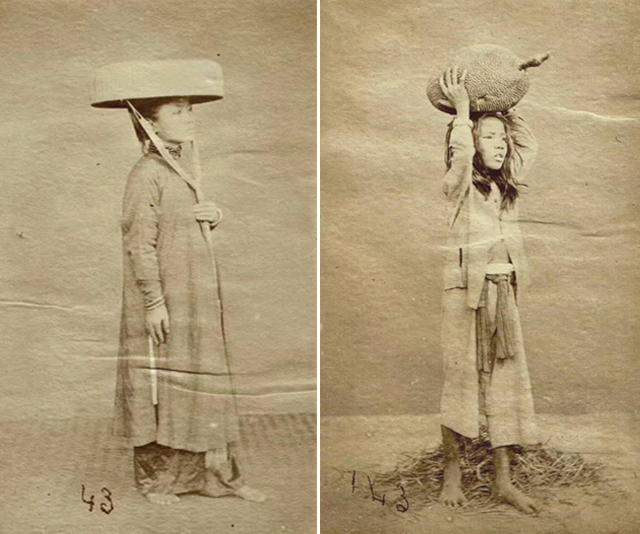
名称: Saigon Girl/西贡女孩
类别: CDV Albumen photo/蛋白照片
日期: 1866-1870
尺寸: 6x9cm each
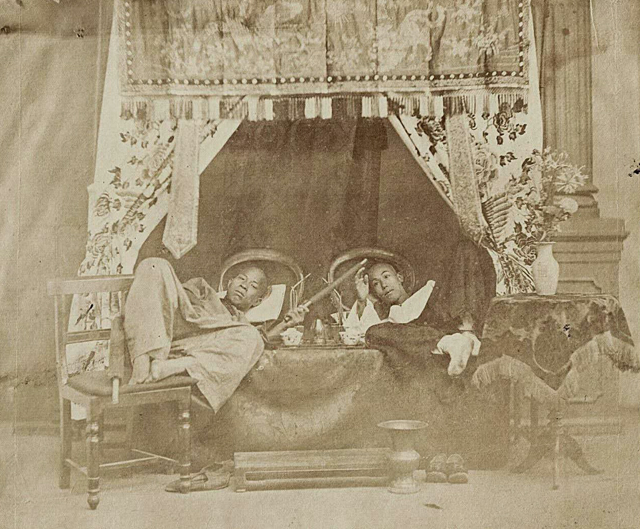
名称: Two men smoking in bed/卧床吸烟的二个男人
类别: Albumen photo/蛋白照片
日期: 1866-1870
尺寸: 16x20cm

名称: Saigon Temple/西贡寺庙
类别: Albumen photo/蛋白照片
日期: 1866-1870
尺寸: 18x30cm
Émile Gsell (1838-1879) was a distinguished 19th-century French photographer, renowned for his early photographic documentation of Southeast Asia, particularly the Angkor temples in Cambodia. A self-taught artist, Gsell accompanied the French Mekong Expedition to Cambodia, producing a remarkable body of work that captured not only architecture and landscapes but also the local customs and daily life, providing invaluable visual records of 19th-century Southeast Asia.
艾米尔·基瑟尔(Émile Gsell,1838-1879)是19世纪法国杰出摄影师,以其对东南亚尤其是柬埔寨吴哥遗址的早期摄影作品而闻名。他自学成才,曾随法国湄公河探险队前往柬埔寨,拍摄了大量珍贵的历史影像,这些作品不仅记录了建筑与风景,更展现了当地民俗风情,为研究19世纪东南亚提供了重要视觉资料。
Gsell’s artistic achievement lies in his mastery of photographic technique and his keen eye for light and composition. Using the wet-plate collodion process, he created images with delicate tonal range and precise framing, producing scenes that are both poetically evocative and historically informative. In Saigon, he established one of the region’s first professional studios, photographing architecture, landscapes, and ethnographic portraits, balancing documentary rigor with artistic sensibility.
His work was exhibited at the Vienna International Exposition, earning accolades, and today is preserved in major institutions such as the Metropolitan Museum of Art, the J. Paul Getty Museum, and the Angkor Database. Though his life was brief, Gsell’s photography remains an essential resource for understanding Southeast Asian history and culture, while also standing as a testament to his enduring artistic vision.
基瑟尔的艺术成就在于他精湛的摄影技艺和对光影、构图的独到把握。他采用湿版胶片技术,以细腻的光线处理和严谨的画面构图,呈现出诗意般的景象,使每一幅作品都兼具纪实价值与艺术感染力。他在西贡开设了摄影工作室,并常往来于香港和广州,是当地最早的职业摄影师之一。其拍摄范围涵盖建筑、风景和民族志肖像,作品既具有科学记录意义,也展现了他敏锐的艺术观察力。
基瑟尔的作品曾在维也纳国际博览会展出并获奖,现被大都会艺术博物馆、Getty博物馆及安哥尔数据库等机构收藏。他短暂的一生中创作的影像,成为后世研究东南亚历史、文化及摄影艺术发展不可或缺的珍贵资料。基瑟尔不仅是历史的记录者,更以独特的视觉语言,赋予影像以艺术的永恒魅力。
CDV (Carte de Visite) was a small-format portrait photography style that became widely popular in Europe and North America in the mid-19th century. Measuring about 6 × 9 cm, the photograph was mounted on a thick card roughly 6 × 10 cm, earning the name “visiting card” photograph. The format was first patented in 1854 by French photographer André Adolphe Eugène Disdéri, whose innovation allowed multiple images to be captured on a single glass plate, making portrait photography more affordable and widely accessible.
Typically produced using the wet-plate or albumen paper process, CDVs offered delicate tonal range and a glossy finish, clearly capturing facial features, clothing, and fine details. Their small size and ease of reproduction enabled clients to share portraits with friends or collect images of notable figures, fostering a culture of photographic exchange and collection.
Beyond individual portraits, CDVs reflected 19th-century social customs, fashion, and class distinctions. They played a pivotal role in the commercialization of photography and influenced the development of postcards and modern portraiture. Today, CDVs are valued as historical artifacts and collectibles, preserved in museums and private collections worldwide, providing essential visual documentation for the study of 19th-century photography and society.
CDV照片(Carte de Visite)是一种在19世纪中期风靡欧洲和北美的小型肖像摄影形式。它通常采用约6 × 9厘米的照片粘贴在约6 × 10厘米的厚卡纸上,因此被称为“名片照片”。CDV最早由法国摄影师安德烈·阿道夫·迪斯德里(André Adolphe Eugène Disdéri)于1854年申请专利,并迅速流行开来,成为当时社交、收藏和纪念的重要工具。
CDV的制作通常采用湿版或蛋白纸(Albumen Paper)工艺,这使得照片呈现细腻的灰度和光泽感,能够清晰记录人物的面部特征与服饰细节。由于体积小且便于复制,摄影师可以一次拍摄多张影像,客户则可将其赠送亲友或收藏名人肖像,形成早期的影像交流与收藏文化。
CDV不仅记录了个人肖像,也反映了19世纪的社会风貌、服饰潮流及阶层特征。它推动了摄影商业化的发展,并为后来的明信片和现代肖像摄影奠定了基础。如今,CDV被视为珍贵的历史文物和收藏品,广泛收藏于博物馆和私人摄影收藏中,为研究19世纪摄影史提供了宝贵的视觉资料。 >>返回>>

 PHOTO影像