 莫里逊个人肖像
Hedda Hammer Morrison (1908-1991) was one of the most significant female photographers active in China during the Republican era. Born in Stuttgart, Germany, she studied photography in Munich and, after graduating, worked as an assistant in studios in Stuttgart and Hamburg. As Nazi influence intensified in Germany, Hedda, like many artists seeking freedom, aspired to travel abroad and escape the political climate at home. She responded to a newspaper advertisement for a manager position at Hatong Photography Studio in Beijing, was hired, and arrived in Beijing in 1933, remaining at the studio until 1938.
赫达·莫里逊/Hedda Hammer Morrison (1908年-1991年),是民国时期在华最为重要的女性摄影师之一。出生于德国的斯图加特,早年在慕尼黑学习摄影,毕业后曾在斯图加特和汉堡担任照相馆的摄影助理。纳粹势力在当时的德国日益膨胀,赫达同很多向往自由的艺术家一样,怀有去外国旅行、逃离本国政治环境的梦想。她在报纸上看到北京的哈同照相馆招聘经理的信息,并顺利得到了这个职位,于1933年抵达北京,一直为哈同照相馆工作至1938年。
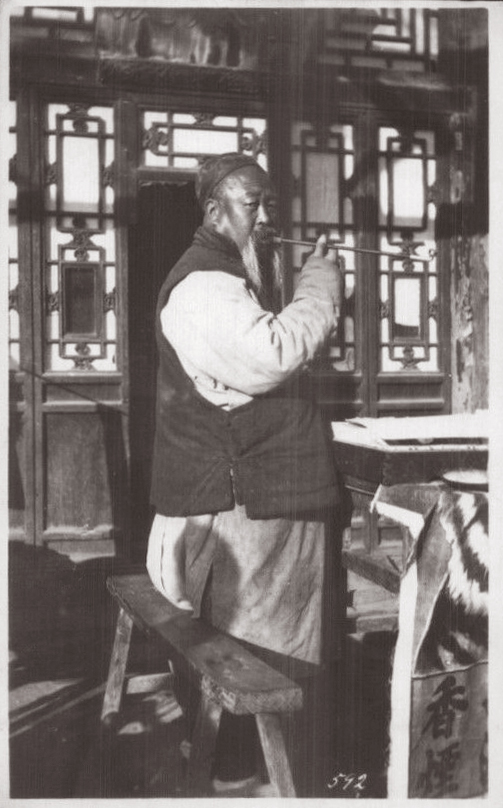 名称: Beijing Grandpa/北京老爷爷
类别: Gelatin Silver Print/银盐照片(手工上色)
日期: 1920s
尺寸: 12x18cm
In 1967, Hedda and her husband settled in Canberra, Australia, where she lived until her death in 1991 at the age of 82. Her photographic legacy, encompassing prints, negatives, and albums, was preserved and donated by her husband, Alastair Morrison, to several research institutions in Australia and the United States. Among the most important collections is that held by the Harvard-Yenching Library, which houses over 5,000 of her photographs taken in China, more than 10,000 negatives, and 28 photographic albums.
Hedda Morrison’s work is valued not only for its documentary importance but also for its artistic merit. Her photographs capture urban and rural life, architecture, and social customs in 1930s China with remarkable clarity and compositional sensitivity. She combined a keen eye for detail with an empathetic approach to her subjects, producing images that are both historically informative and aesthetically compelling. Today, her photographs are preserved in museums, libraries, and academic collections, serving as vital resources for historians, scholars, and art enthusiasts. Morrison’s oeuvre continues to be celebrated for its unique combination of documentary precision, cultural insight, and artistic vision, making her one of the most distinguished photographers of her generation working in China.
1938年后,她离开哈同照相馆,开始了自由摄影师的生涯。1946年,与在北京出生的澳大利亚人阿拉斯泰尔·莫里逊(Alastair Morrison,1915-2009) 结婚。结婚后,赫达随丈夫在中国的不同地方工作、旅行、拍摄,直至1946年底离开中国之前,她曾拍摄过云冈石窟(1933 年)、河北正定(1934 年)、热河(1934-1935 年)、山西华山(1935 年)、河北(1936 年)、山东威海卫和青岛(1937 年)、河北保定(1940 年)、山东曲阜和泰(1942 年)和南京(1944年)。 1979年年莫里森夫妇最后一次回到北京时,北京已经不再是他们住过的北京了。这时,他们才意识到她的那些摄影的历史价值。于是她就从她所拍的北京照片中,选编一册《一个摄影师在老北京》195年出版,为老北京留下了一些见证。 1967年,赫达与丈夫定居澳大利亚首都堪培拉,1991年去世,享年82岁。赫达去世后,其丈夫阿拉斯泰尔·莫里逊将她的照片和底片捐赠给澳大利亚和美国的几家研究机构。其中,哈佛燕京图书馆收藏了她在中国拍摄的五千多张照片、一万多张底片以及28本像册。
赫达·莫里逊的作品不仅具有重要的历史价值,同时也具有显著的艺术价值。她的摄影作品记录了1930年代中国的城市与乡村生活、建筑景观以及社会风俗,画面清晰、构图精妙。她以敏锐的观察力和对被摄者的同理心,使作品既具有历史纪实性,又富有美学感染力。今天,赫达的照片被收藏于博物馆、图书馆和学术机构,成为历史学者、研究者和艺术爱好者的重要研究资料。她的摄影作品以兼具纪实精确性、文化洞察力与艺术视野的独特风格,被视为在华摄影史上最杰出的摄影师之一。 >>返回>>

 PHOTO影像