 名称: Mount Everest in the Himalayas/喜马拉雅山珠穆朗玛峰
类别: Albumen Print/蛋清照片
日期: 1900s
尺寸: 20x26cm
名称: Mount Everest in the Himalayas/喜马拉雅山珠穆朗玛峰
类别: Albumen Print/蛋清照片
日期: 1900s
尺寸: 20x26cm
 名称: Mount Everest in the Himalayas/喜马拉雅山珠穆朗玛峰
类别: Collodion Printing/火棉胶照片
日期: 1905
尺寸: 28x57cm
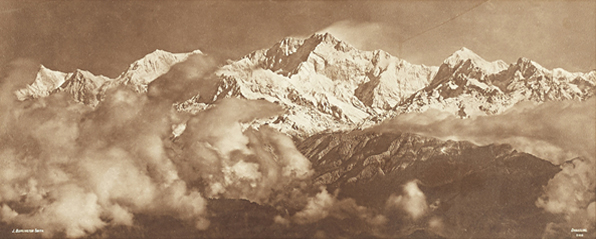 名称: Mount Everest in the Himalayas/喜马拉雅山珠穆朗玛峰
类别: Collodion Printing/火棉胶照片
日期: 1905
尺寸: 28x57cm
 名称: Mount Everest in the Himalayas/喜马拉雅山珠穆朗玛峰
类别: Collodion Printing/火棉胶照片
日期: 1905
尺寸: 28x57cm
J. Burlington Smith — There is very little information available about him personally. It is believed that he was a British photographer residing in Darjeeling, India, sometime between 1900 and 1920, focusing on photographing the Himalayas and the Tibetan people living around Darjeeling. Although the number of his surviving works is limited, they are all finely crafted and bear his signature.
伯灵顿·史密斯/J. BURLINGTON SMITH,关于他本人的资料很少,推测他应该在1900年-1920年之间居住在印度大吉岭的英国摄影师,以拍摄喜马拉雅山脉和大吉岭周边藏民为主,他留在世面上的摄影作品不多但都制作精美并且有他本人签名。
Darjeeling, located near the India-China border and close to the Himalayas, is also near Nepal, Bhutan, and Sikkim. Situated at an altitude of 3,000 to 7,000 feet, it is shrouded in mist throughout the year and receives abundant rainfall, creating an ideal environment for tea cultivation. The Darjeeling Himalayan Railway was designated a UNESCO World Heritage site in 1999. This railway connects the town with the plains below and is one of the few railways in India still using steam locomotives.
“Darjeeling Tea” — In 1839, British colonists, eager to acquire China’s tea cultivation techniques, instructed the East India Company to send a man named Robert disguised as a Chinese person to secretly obtain tea seeds from China. Robert shaved his head and, disguised as a local, ventured into Anhui Province, an area where foreigners were prohibited under the Qing Dynasty. Using various methods, he acquired tea seeds and cultivation knowledge, which were then transported to India via Shanghai. Between 1839 and 1860, Robert made four trips to China. In February 1851, he brought 2,000 young tea plants, 17,000 germinating tea seeds, and coerced eight Chinese tea experts to travel to India to teach tea cultivation.
British writers Toby Musgrave and Will Musgrave acknowledge this unethical act of stealing Chinese tea in their book Plants That Changed the World.
大吉岭(Darjeeling)位于印度与中国交界处,近喜马拉雅山脉,附近有尼泊尔、不丹、锡金等国。 大吉岭海拔3000 至7000 英尺,终年被云雾所笼罩,雨水充沛,环境极适合茶树生长。大吉岭喜马拉雅铁路于1999年被联合国教科文组织宣布为世界遗产,铁路将市镇和山下的平原连接起来,是印度少数还在使用的蒸汽机车的铁路之一。
“大吉岭红茶”-1839年英国殖民者垂涎中国茶叶种植技术,指使东印度公司派罗伯特乔装打扮去中国盗窃茶种,罗伯特把自己的头发剃掉,扮成中国人深入到清朝政府禁止外国人进入的安徽地区,用各种手段获取当地的茶树种子和栽培技术经上海运至印度。罗伯特从1839年到1860年期间四次来华,1851年2月通过海路将2000株茶树小苗、1.7万粒茶树发芽种子,以及威逼八名中国茶农到印度指导茶叶种植。英国作家托比·马斯格雷夫(Toby Musgrave)和威尔‧马斯格雷夫(Will Musgrave)合作出版《改变世界的植物》书中承认了英国人偷窃中国茶叶的卑鄙行为。 >>返回>>

 PHOTO影像