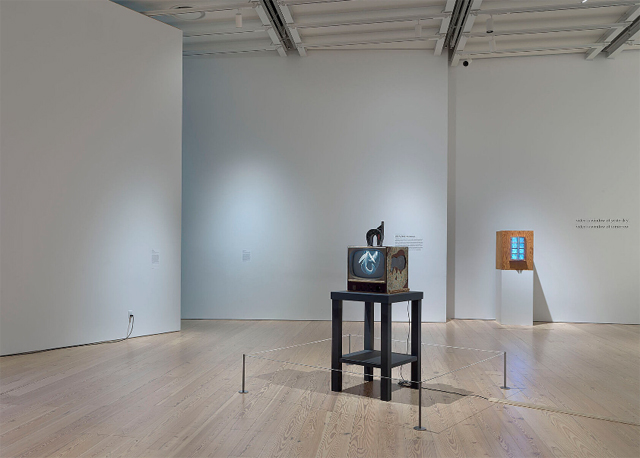

名称: Magnet TV/磁铁电视
日期: 1965
馆藏:35mm幻灯片
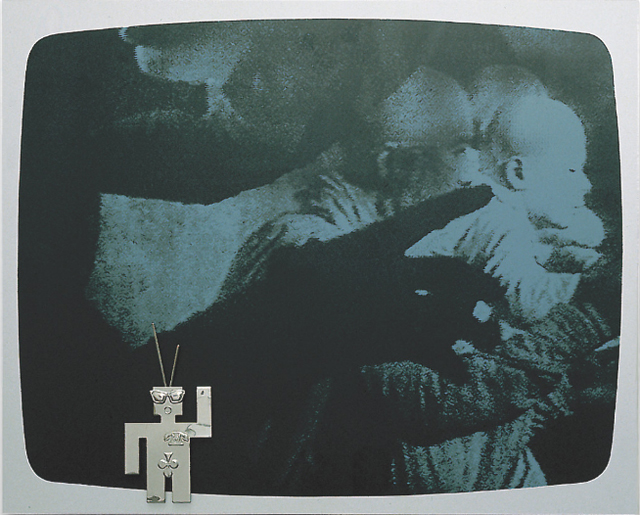
名称: Nevada FallVideo Sonata op. 57/录像奏鸣曲,作品57号
日期: 1995
馆藏:35mm幻灯片
白南准(Nam June Paik, 1932-2006)是韩裔美籍国际著名影像艺术家,被誉为“录像艺术之父”。他最初是音乐家和作曲家,1963年在德国举办首次个展,展出改造电视机的装置《禅之电视》,成为用电视机表现艺术的第一人。1965年,他用便携摄像机在纽约创作视频作品,成为最早的视频艺术家。1970年,他与工程师阿部修也合作发明了录像合成器,可混合多重影像。他的代表作品包括《全球槽》(1973)、《电视花园》以及巨型视频墙《电子高速公路》(1995)等,深刻影响了当代艺术的发展。
白南准的作品被全球众多顶级机构收藏。史密森尼美国艺术博物馆于2009年获得了其完整遗产档案,成为研究白南准的国际中心,并永久展出《禅之电视》、《电子高速公路》 等作品。此外,纽约古根海姆博物馆藏有《电视花园》 ;巴德学院赫塞尔艺术博物馆藏有《惠特尼佛陀复合体》 。他的作品也收藏于惠特尼美国艺术博物馆、泰特现代美术馆、旧金山现代艺术博物馆、澳大利亚新南威尔士美术馆、韩国国立现代美术馆以及韩国 WooYang 美术馆等,足见其全球性的艺术影响力。
Nam June Paik (1932-2006) was a Korean-American internationally renowned video artist, widely regarded as the “Father of Video Art.” Originally a musician and composer, he held his first solo exhibition in Germany in 1963, where his altered television installation Zen for TV pioneered the use of television as an artistic medium. In 1965, he created video works in New York using a portable camera, becoming one of the earliest pioneers of video art. In 1970, he co-invented the video synthesizer with engineer Shuya Abe, revolutionizing multi-image video production. His landmark works include Global Groove (1973), TV Garden, and Electronic Superhighway (1995), which profoundly influenced contemporary art.
Paik’s works are held by major institutions worldwide. In 2009, the Smithsonian American Art Museum acquired his complete archival estate and has preserved and exhibited works including Zen for TV and Electronic Superhighway. The Solomon R. Guggenheim Museum holds TV Garden, while the Hessel Museum of Art at Bard College holds Whitney Buddha Complex. His works are also represented in the collections of the Whitney Museum of American Art, Tate Modern, San Francisco Museum of Modern Art, and National Museum of Modern and Contemporary Art, Korea, underscoring his lasting international significance in art history. >>返回>>