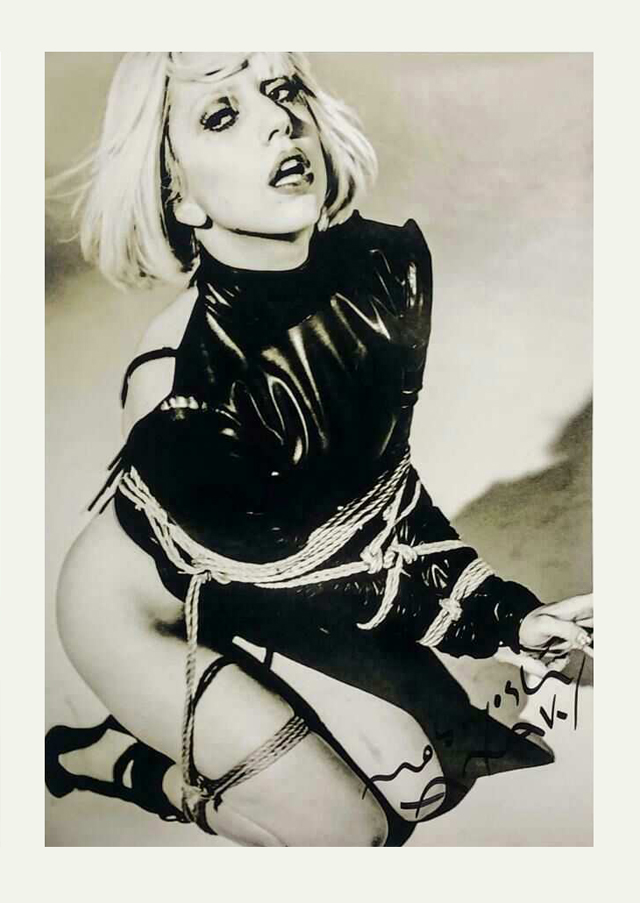
名称: Kinbaku/绳缚
类别: Gelatin silver print/银盐照片
日期: 1970s
尺寸: 30×40cm
备注: 此照片右下有荒木经惟本人签名


This is a quintessential photographic work by Nobuyoshi Araki, rendered in black and white, with the central figure bound by ropes, evoking the Japanese concept of Kinbaku (erotic bondage). Since the 1970s, Araki has continuously explored the imagery of eroticism and desire, merging traditional Japanese bondage culture with contemporary photographic language to create highly charged visual effects. Such works often move along the boundary between eroticism and art, simultaneously representing bodily restraint and sensory tension, while also symbolizing the interplay of life, desire, and death.

The subject in the image is dressed in glossy black latex, posed with strong theatricality and performative intensity. With eyes directly confronting the viewer, the expression conveys both provocation and vulnerability. This reflects Araki’s core idea of “Eros = Thanatos,” revealing the intensity and fragility of life through the extremities of sensual experience. The artist’s signature on the work further emphasizes its uniqueness as an art object.

Araki’s photographs of this kind are widely collected by major art institutions worldwide, including the Museum of Modern Art in New York (MoMA), Tate Modern in London, and the Centre Pompidou in Paris, among others, where his erotic series has been exhibited. This particular piece exemplifies his iconic Kinbaku photography style, marking a distinctive place in the history of contemporary photography.

这是一幅荒木经惟(Nobuyoshi Araki)具有典型风格的摄影作品,画面采用黑白影像,主体人物被绳索缠绕,以日本“绳缚(Kinbaku)”意象为主题。荒木自1970年代开始便持续探索情色与欲望的影像表现,他将日本传统绳缚文化与现代摄影语言结合,形成极具张力的视觉效果。这类作品常在情色与艺术的边界间游走,既表现了身体的束缚与感官的冲突,也隐喻生命、欲望与死亡的张力。

画面中的人物身着黑色乳胶质感服饰,姿态带有强烈的戏剧性与表演性,眼神直视观者,呈现出挑衅与脆弱并存的情绪。这正体现了荒木作品中的“情色=生死”观念:在感官的极限中揭示生命的强度与脆弱。他在作品上留下签名,更突出了摄影作为艺术品的唯一性。

此类荒木的摄影常被世界各大艺术机构收藏,例如纽约现代艺术博物馆(MoMA)、伦敦泰特现代美术馆(Tate Modern)、法国蓬皮杜艺术中心(Centre Pompidou)等,均曾展出其情色系列作品。这张作品正是他最具代表性的“绳缚写真”风格之一,在当代摄影史上具有鲜明标志性。

Nobuyoshi Araki (born in Tokyo in 1940) is one of the most controversial and influential contemporary Japanese photographers, renowned for his highly personal visual language and bold explorations of life, death, eroticism, and the everyday. Since the 1960s, Araki has established his distinctive style with the Sentimental Journey series, using photography as a form of autobiographical expression. By intertwining images of his wife, flowers, cityscapes, and erotic motifs, he created a unique aesthetic of “I-Photography” (shishashin). He frequently employs film, Polaroid, and hand-coloring techniques, producing images imbued with sensuality, immediacy, and a narrative force that reflects the passage of life.

Araki’s works have had a profound global impact and are held in the collections of major art institutions, including the Museum of Modern Art in New York (MoMA), the San Francisco Museum of Modern Art (SFMOMA), Tate Modern in London, the Centre Pompidou in Paris, the Museum für Fotografie in Berlin, and the National Museum of Modern Art in Tokyo, among others. His photography is not only an extreme record of personal life experiences but also a challenge to the boundaries between art and society, securing his significant place in the history of contemporary photography.

荒木经惟(Nobuyoshi Araki,1940年生于东京)是日本当代最具争议与影响力的摄影师之一,以其高度个人化的影像语言和大胆探索生死、情色与日常而闻名。荒木自1960年代起便以《感伤之旅》系列奠定风格,他将摄影作为自传体的表达方式,将妻子、花卉、街景与情色元素交织,形成独特的“私写真”美学。他大量使用胶片、拍立得和手工上色,影像充满感性、瞬间性与生命流逝的叙事力量。

荒木的作品在全球范围内具有广泛影响,被许多重要艺术机构收藏。例如,纽约现代艺术博物馆(MoMA)、旧金山现代艺术博物馆(SFMOMA)、伦敦泰特现代美术馆(Tate Modern)、法国蓬皮杜艺术中心(Centre Pompidou)、德国柏林摄影博物馆(Museum für Fotografie)、东京国立近代美术馆(The National Museum of Modern Art, Tokyo)等均收藏其代表作品。他的摄影不仅是对个人生命经验的极端记录,也挑战了艺术与社会的界限,在当代摄影史上占有重要地位。>>返回>>
 PHOTO影像