
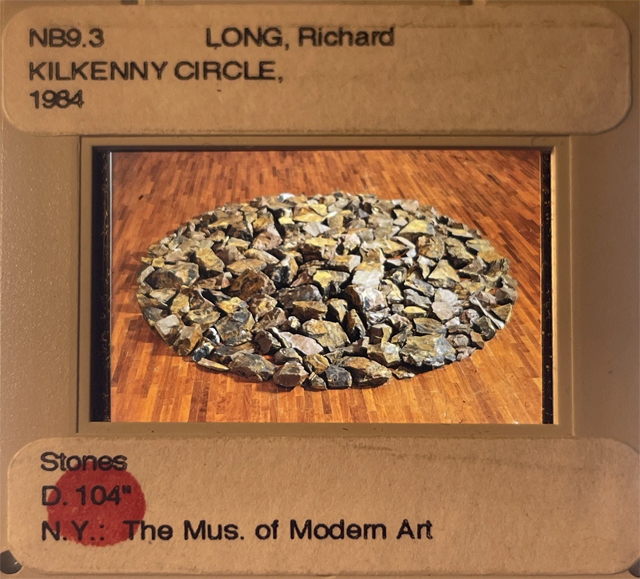
名称: Kilkenny Circle/基尔肯尼圆环
日期: 1984
馆藏:35mm幻灯片


理查德·朗(Richard Long,1945-)是20世纪后半叶最重要的英国当代艺术大师,是大地艺术(Land Art)和观念艺术的重要代表人物,与 Robert Smithson、Walter De Maria 等共同推动了20世纪60-70年代艺术从传统物质对象向自然、空间和行走经验的转变。

《基尔肯尼圆环/Kilkenny Circle》是朗以自然材料和空间观念创作的重要作品之一。作品延续了他长期探索“行走—自然—时间—地点”关系的艺术方法。通过将石头等自然材料排列成圆形结构,朗将简单的地景元素转化为具有秩序感和精神性的艺术形式。圆形既象征自然循环,也体现艺术家对空间、尺度和人与环境关系的持续思考。作品强调过程、地点和体验,而非传统意义上的永久物体。

理查德的作品被泰特现代美术馆(Tate Modern)、纽约现代艺术博物馆(MoMA)、大都会艺术博物馆(The Met)、古根海姆博物馆、蓬皮杜中心、芝加哥艺术学院等世界重要机构收藏。其摄影、绘画和地景作品具有重要的当代艺术史、大地艺术、观念艺术及博物馆收藏价值。《基尔肯尼圆环》代表了朗将自然、极简形式与哲学思考结合的艺术实践,是研究20世纪后期艺术观念转型的重要作品。

Richard Long|Master of Land Art
Richard Long (1945-) is one of the most important British contemporary artists of the late 20th century and ranks among the first tier of masters in contemporary art history. He is a leading figure in Land Art and conceptual art, and, together with artists such as Robert Smithson and Walter De Maria, helped transform artistic practice in the 1960s and 1970s from traditional objects toward nature, space, and the experience of walking.

Kilkenny Circle is an important work that reflects Long’s long-term exploration of the relationship between walking, nature, time, and place. Using natural materials such as stones arranged into a circular form, Long transforms simple elements of the landscape into a work with a strong sense of order and spiritual presence. The circle suggests natural cycles while expressing the artist’s continuing investigation of space, scale, and the relationship between humans and the environment. The work emphasizes process, location, and experience rather than a traditional permanent object.

Richard Long’s works are held by major institutions including Tate Modern, the Museum of Modern Art (MoMA), The Metropolitan Museum of Art (The Met), the Solomon R. Guggenheim Museum, Centre Pompidou, and the Art Institute of Chicago. His photographs, drawings, and land-based works hold significant contemporary art, Land Art, conceptual art, and museum-collection value. Kilkenny Circle represents Long’s influential practice of combining nature, minimal form, and philosophical reflection, making it an important work for understanding the transformation of late 20th-century art. >>返回>>


