
名称: The Roaring Lion/咆哮的丘吉尔
类别: Gelatin silver print/银盐照片
日期: 1941
尺寸: 22×30cm
Note: 《愤怒的丘吉尔》”这个标题来源于尤素夫·卡什(Yousuf Karsh)拍摄温斯顿·丘吉尔肖像的背景与效果。1941年,卡什在伦敦议会大厦拍摄丘吉尔时,丘吉尔刚刚在二战期间发表鼓舞人心的演讲,情绪激动且坚毅。拍摄过程中,丘吉尔的面部表情呈现出紧绷、坚定甚至带有怒意的神态,这种表情传达出他对敌人的强烈反抗与不屈精神。因此,媒体和公众习惯性地将这幅肖像称为“愤怒的丘吉尔”,既体现他个人的坚毅性格,也象征他在二战时期的领导风采。这个标题并非卡什官方命名,而是后世为了强调肖像的情感张力和象征意义而使用的描述性名称。
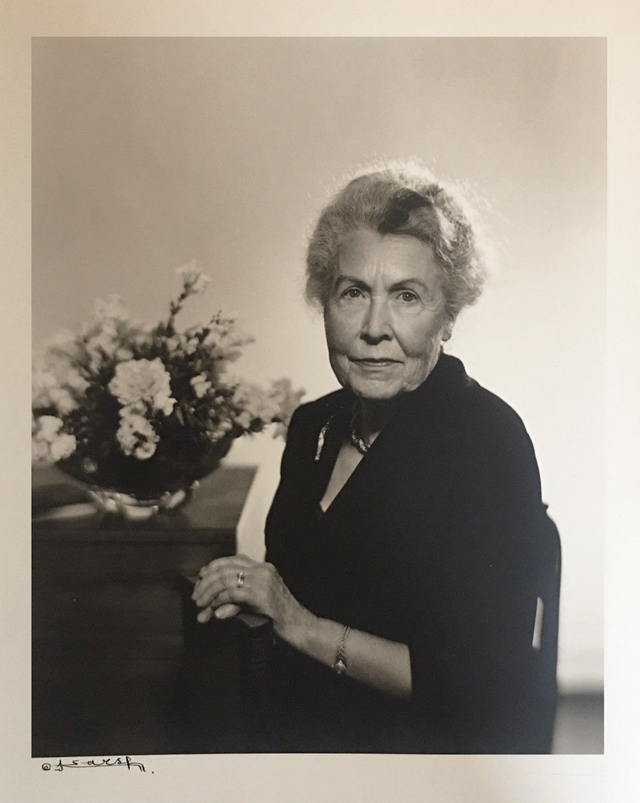

名称: Naomi Burnett/娜奥米·伯内特(1893-1990)
类别: Gelatin silver print/银盐照片
日期: July 22, 1965
尺寸: 33x40cm
Note: 尤瑟夫·卡什(Yousuf Karsh)于1965年7月22日在其工作室为娜奥米·伯内特(Naomi Burnett,著名广告人雷奥·伯内特的夫人)拍摄肖像。拍摄时娜奥米年已72岁,此次拍摄的编号为#12560,并被完整收录在卡什基金会档案中。
在这幅肖像中,娜奥米优雅地坐在桌旁的凳子上,手中持着一本书,目光轻轻望向远方,桌上放置着一盆精致的花卉,为画面增添了生活气息和柔和的色彩层次。作为广告界传奇人物雷奥·伯内特的妻子,72岁的娜奥米依然展现出从容、自信与端庄,这为卡什创作富有表现力的肖像提供了理想条件。
拍摄前,卡什通常会与被摄者进行交流,了解其性格、公众形象和情绪特质,以确定肖像的主题和氛围。他强调光线的塑造作用,在此次拍摄中可能使用柔和的主光与侧光,突出面部轮廓,同时运用阴影增加画面深度与戏剧感。桌上的花和娜奥米持书的姿态形成了巧妙的构图,既增强了视觉平衡,又体现了人物的文化气质与精神状态。
拍摄过程中,卡什精心调整坐姿、手部位置、面部表情和眼神方向,通过相机高度、焦距和光圈捕捉最自然、最具艺术感染力的瞬间。72岁的娜奥米在镜头前展现出的优雅与尊严,体现了卡什“以光雕塑”的理念:通过精准光影和巧妙构图,使人物在二维影像中呈现立体感和心理深度。这张肖像不仅记录了她的形象,也成为卡什中期肖像作品的典型代表,兼具艺术美感与历史价值,为研究20世纪中叶西方肖像摄影提供了宝贵资料。
Yousuf Karsh (1908–2002) created a classic portrait of the renowned American writer Pearl S. Buck (1892–1973), recorded as Sitting no. 11475, in the mid-20th century. Although born in the United States, Buck spent much of her childhood and youth in China, gaining profound insight into rural society and the lives of ordinary people. This formative experience shaped her literary career, inspiring works such as The Good Earth, which vividly depicted the struggles and resilience of Chinese farmers. The novel won the Pulitzer Prize in 1932, and in 1938 Buck was awarded the Nobel Prize in Literature, becoming a vital cultural bridge between East and West.
During the sitting, Karsh applied his signature artistic approach: a simple background, precise lighting, and acute psychological perception. Using soft illumination, he emphasized Buck’s facial expression, which combined the rationality of a Western intellectual with the warmth instilled by her immersion in Chinese culture. In this portrait, her contemplative and serene demeanor conveys a profound awareness of cross-cultural dialogue. The image thus stands not merely as a likeness, but as a visual testament to her humanitarian spirit and cultural mission.
Yousuf Karsh (1908-2002) was one of the most influential portrait photographers of the 20th century, often hailed as a “visual chronicler of history’s figures.” Born in Armenia, he emigrated to Canada as a young man following the Armenian Genocide and studied under the renowned photographer François Hébert in Montreal, which laid the foundation for his photographic career. Karsh was celebrated for capturing the personality and psychological depth of his subjects. His portraits emphasized light, composition, and detail, while conveying the inner character and spirit of the era. His subjects included political leaders, artists, scientists, and cultural icons such as Winston Churchill, Mahatma Gandhi, Albert Einstein, and Marilyn Monroe, making his work an essential visual archive of 20th-century history and culture. Karsh’s artistic achievements are evident in his precise control of lighting, the strength of his compositions, and his deep insight into human psychology. His portrait style features dramatic shadows, clear contours, and concise expressions, giving his subjects strong individuality and symbolic presence. His work is held in major museums worldwide, including the Museum of Modern Art (MoMA) in New York, the National Portrait Gallery in Washington, D.C., the National Gallery of Canada in Ottawa, and the National Portrait Gallery in London, ensuring the lasting preservation and influence of his artistic and historical contributions.
One of Karsh’s most famous sessions was the 1941 portrait of Winston Churchill for Time magazine, taken in the Houses of Parliament in London. During the approximately 75-minute session, Karsh engaged with Churchill to adjust his posture and expression. Observing Churchill’s stubborn, tense demeanor, Karsh asked his assistant to temporarily remove the cigar to minimize distractions and guided Churchill to slightly tilt his body. Using strong key lighting combined with soft fill lighting, Karsh captured Churchill’s resolute and determined expression. This portrait became an iconic symbol of Western leadership during World War II and solidified Karsh’s legendary status in global portrait photography.
尤素夫·卡什(Yousuf Karsh,1908-2002)是20世纪最具影响力的肖像摄影师之一,被誉为“历史人物的视觉记录者”。他出生于亚美尼亚,年轻时因亚美尼亚种族大屠杀迁至加拿大,在蒙特利尔师从著名摄影师François Hébert,奠定了其摄影基础。卡什以捕捉人物性格与心理深度著称,他的肖像作品不仅强调光影、构图与细节,更通过摄影语言展现人物的内在气质和时代精神。其被摄对象涵盖政治家、艺术家、科学家及文化名流,包括丘吉尔、甘地、爱因斯坦、玛丽莲·梦露等,使其作品成为20世纪历史与文化的重要影像档案。
卡什的艺术成就体现在其对光线的精确控制、构图的简洁力量以及对人物心理的深刻洞察。他的肖像风格强调深邃的阴影、明确的轮廓和凝练的表情,使被摄者形象具有强烈的个性化和象征性。他的作品被全球顶级博物馆收藏,如美国纽约现代艺术博物馆(MoMA)、美国华盛顿国家肖像馆(National Portrait Gallery)、加拿大国家美术馆(National Gallery of Canada)、英国国家肖像馆(National Portrait Gallery, London)等,确保了其艺术与历史价值得到长期保存与传播。
尤素夫·卡什最著名的拍摄经历之一是1941年为《时事通讯》拍摄温斯顿·丘吉尔肖像。拍摄地点位于伦敦议会大厦,卡什用约75分钟与丘吉尔沟通与调整姿势。当丘吉尔面带倔强表情坐下时,卡什发现其紧张神态,遂要求助手暂时移走雪茄以减少干扰,并指导丘吉尔微微倾斜身体。通过强烈主光与柔和补光的运用,他捕捉到了丘吉尔坚毅、果敢的神情。这张肖像后来成为二战时期西方领导人的象征,也奠定了卡什在全球肖像摄影中的传奇地位。>>返回>>
 PHOTO影像